Why change deserves an event

Every organisation changes. A merger, a reorganisation, new leadership, a strategic shift in direction. The plans are on paper. The PowerPoint has been signed off. And then what? Then it has to land. With real people, with real worries and expectations.

That doesn't work with an intranet post. Not with a Teams meeting where 400 people sit with their microphones off. Change calls for a moment. A physical turning point where people hear and feel the message. Where they can ask questions. Where they see the faces of those who took the decision.

A change communication event does exactly that. It creates space for the message and for the response to it. It shows that the organisation takes the change seriously enough to make it a moment. And that matters, more than you think.

What makes a change communication event different?

This is not a party and not a drinks reception with a speech in the middle. A change moment is a carefully directed event in which every minute matters. The tone has to be right. The message has to be clear. And there has to be room for emotion: it will come, whether you plan for it or not.

The difference from a regular company event lies in the dramaturgy. You build an arc. First you acknowledge the past. Then you show the urgency of the present. Finally you sketch the perspective for the future. That structure is not decorative but functional. Without that arc, the message stays in people's heads. With that arc, it touches the feeling too.

We have guided change journeys at mergers, splits, leadership changes and culture programmes. Every situation is different. But one thing always returns: the event is the moment when the change really begins, not on paper but in the minds of the people who have to make it happen.

Formats that work for change communication

There is no single format that always works. But there are proven forms that you can combine, depending on the scale, the message and the emotional charge.

Plenary gathering with breakout groups: the leadership team tells the big story plenary. Afterwards, teams break out into smaller groups to discuss what it means for them. This works well for reorganisations and strategy shifts. It gives people the feeling that they are being heard, not merely informed.

Travelling presentation: the same message, multiple locations. This works for organisations with sites across the country and is more personal than a live stream. The leadership team comes to the people, instead of the other way around. That is a signal in itself.

Co-creation session: building together rather than just telling. Let employees think along about how the change is shaped. This suits culture programmes and innovation programmes. The risk is that it has to be real: fake participation is worse than no participation.

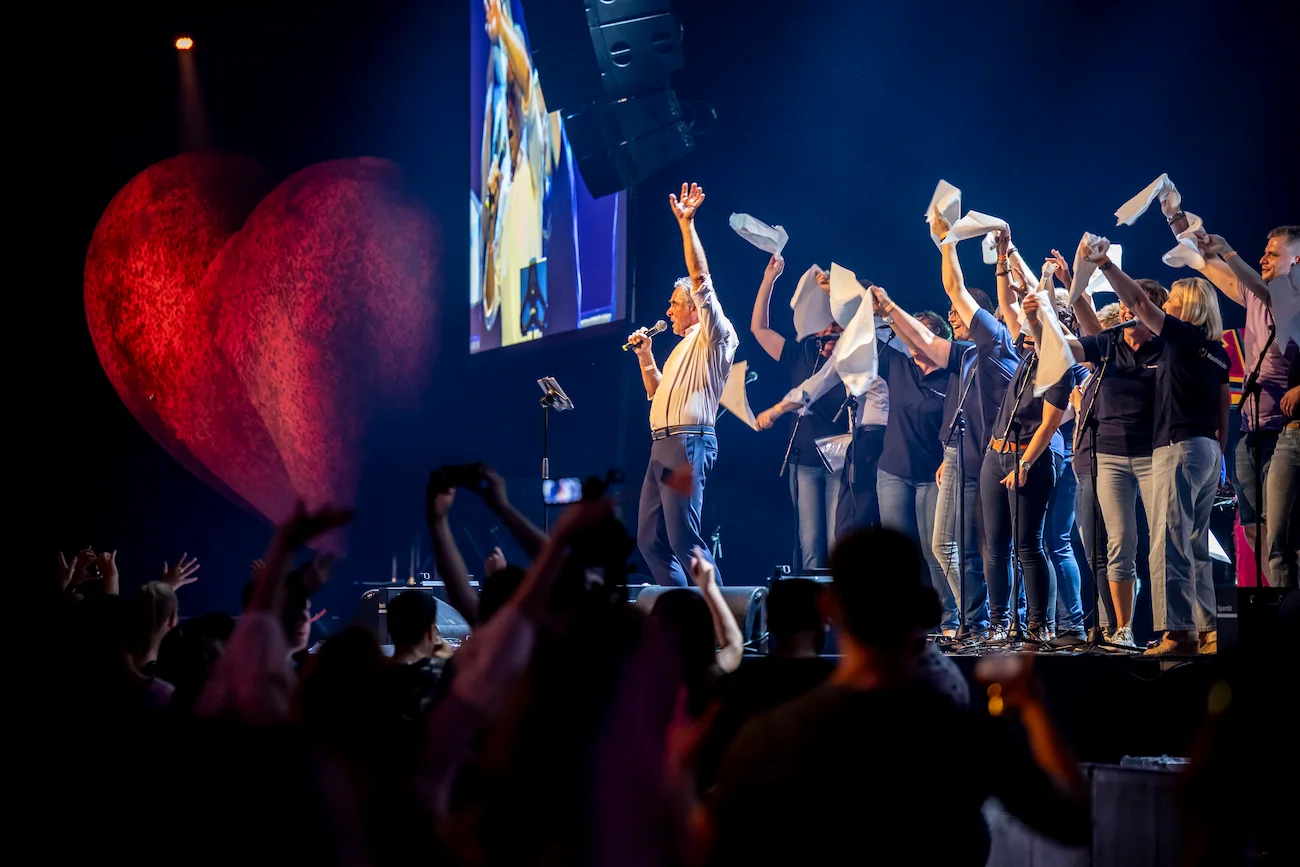
Experiential event: this is the most striking variant. Build an environment in which people experience the change. Think of a guided tour, an installation, a theatrical presentation. It is sometimes expensive, but always effective. This format leaves an impression that lingers, long after the slides are forgotten.

The right venue for a change event

Venue choice in change communication is strategic. If you go to an external venue, you mark a break with the everyday. That reinforces the message: this is different, this is new. If you stay at the office, you say: this is part of who we are. We do this here, together.

Both choices are defensible. It depends on the nature of the change. For a merger, a neutral venue works: no home advantage for either side. For an internal culture programme, it can actually be powerful to transform your own workplace. Turn it into a place people don't recognise.

What always holds is that the space facilitates the conversation. Don't use a hall where everyone sits in rows. Choose round tables, group corners and informal zones. Let the layout of the space support the message: we are doing this together, on a level footing.

Pitfalls in change communication events

The biggest pitfall is broadcasting too much and listening too little. If employees get the feeling that the event is a sales pitch for a decision already made, you lose them. Make room for questions, including the difficult ones.

The second pitfall is hiding the message in vagueness. Be concrete. What changes, for whom and when? And what does it mean for jobs, teams and ways of working? People have a right to clarity. A pretty story without substance is worse than an ugly story with honesty.

The third pitfall is treating the event as an end point, when it is a starting point. Plan the follow-up before you book the room. Who answers questions afterwards, when does the next update come, and how can people respond? An event without a follow-up is a promise without delivery.

Finally, don't underestimate the emotion. Change provokes resistance. That is normal and healthy. Give that resistance a place in your programme. Acknowledge the past before you start on the future. People only let go when they feel that what was, has been seen.

Why bring in an agency for change communication?

Change touches the whole organisation. That makes it hard to direct objectively from the inside. You are in the middle of it. You know the politics, the sensitivities, the internal relationships. That is valuable knowledge. But it also blinds you to how the message lands on someone hearing it for the first time.

An external agency brings distance. We look at your story the way your audience does. We ask the questions that nobody internally dares to ask. About the clarity of the message, the honesty of it and the space for the emotion it stirs up.

Live Impact has guided change moments for organisations of 50 to 5,000 employees. We write the story, design the format, choose the venue and direct the day. So you can focus on what matters: being there for your people at the moment that counts.

Change starts with a conversation

Facing a change and want to know how best to communicate it? Call us, not for a quote but for a conversation. We're happy to think along on the approach, the format and the story: no strings, sharp, with experience that takes you further.

Call 085 401 40 14, email hello@live-impact.nl or fill in our online brief. We respond within 24 hours.

Seriously fun.

Frequently asked questions

Wanneer zet je een evenement in voor verandercommunicatie?

Een verandercommunicatie-evenement werkt het best bij ingrijpende veranderingen die begrip, draagvlak of gedragsverandering vereisen — zoals reorganisaties, fusies, nieuwe strategie of cultuurverandering. Kleine updates lopen via reguliere kanalen; voor grote koerswijzigingen is een live moment met directe interactie onvervangbaar.

Meer weten over verandercommunicatie via evenementen? Lees ons complete artikel →

Wat maakt een veranderevenement anders dan een gewone townhall?

Een townhall informeert. Een verandercommunicatie-evenement overtuigt en beweegt. Het verschil zit in de opbouw: minder zenden, meer dialoog, en een programma dat ruimte geeft voor weerstand, vragen en emotie.

Verandering landt niet via een PowerPoint — het landt via beleving, verhalen en directe betrokkenheid.

Meer weten over verandercommunicatie via evenementen? Lees ons complete artikel →

Welke formats werken bij verandercommunicatie-evenementen?

Effectieve formats zijn de townhall met breakouts, de scenariosessie, de leaderreis en de inspiratiedag met externe verhalen. In een scenariosessie speel je de verandering letterlijk door. De leaderreis stuurt het management op pad door de eigen organisatie. De keuze hangt af van de fase: aankondiging, begrip of commitment.

Meer weten over verandercommunicatie via evenementen? Lees ons complete artikel →

Wat zijn de grootste valkuilen bij verandercommunicatie via evenementen?

Er zijn drie veelvoorkomende fouten. Eerste: te veel zenden en te weinig ruimte voor reactie. Tweede: de verandering als voldongen feit presenteren terwijl mensen nog in de ontkenningsfase zitten. Derde: de opvolging vergeten. Een veranderevenement zonder concrete vervolgacties laat mensen met meer vragen dan antwoorden.

Andere valkuil: het evenement los organiseren van de bredere communicatiestrategie. Het evenement moet passen in een doorlopend verhaal, niet als losstaand moment staan. Live Impact denkt mee over de samenhang van de hele verandercommunicatie.

Meer weten? Lees ons complete artikel →

Kan Live Impact een verandercommunicatie-evenement begeleiden?

Ja. Live Impact begrijpt dat verandering een emotioneel proces is, niet alleen informatieoverdracht.

We ontwikkelen evenementen die ruimte geven voor weerstand. Daarnaast vertellen we verhalen die de verandering tastbaar maken. Zo zorgen we dat het programma mensen meeneemt en niet alleen informeert.

Meer weten over verandercommunicatie via evenementen? Lees ons complete artikel →

Inspired
Moved?

Thank you!
Oops! Something went wrong while submitting the form.